
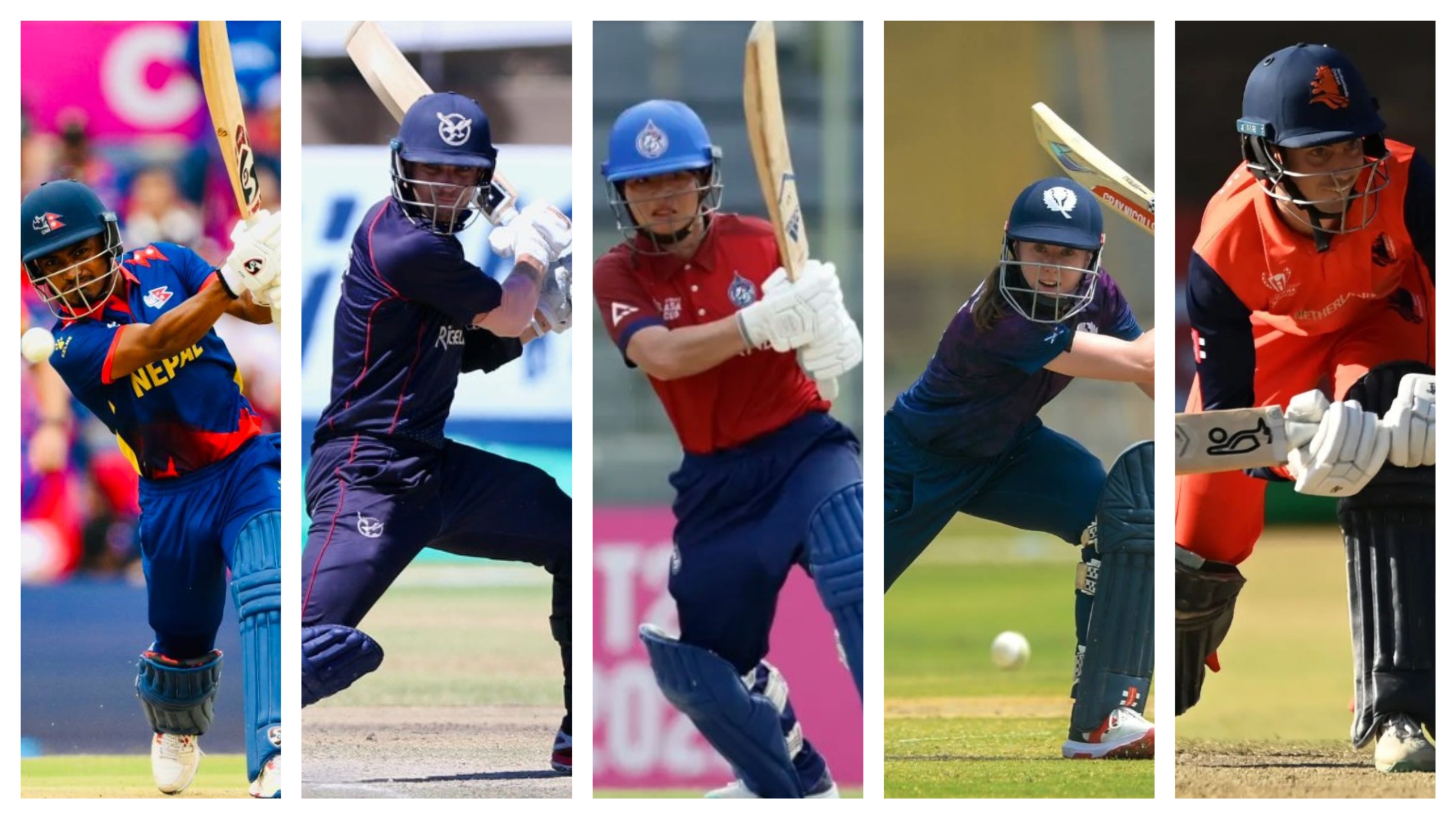
The official classification for matches involving Full members and Associate member countries were updated by International Cricket Council (ICC) from 01st July 2026, and amendments were approved for matches featuring Associate Member Teams, during the ICC Board meetings on May 30th and 31st, 2026, in India. Below are the updated ICC rules as defined for the matches involving countries with Associate membership under the ICC (A total of 98 countries).
One-Day Internationals
ODI matches are those matches which:
a) Are played in accordance with the ICC Standard Men’s and Women’s One Day International Playing Conditions and other ICC regulations pertaining to ODI Matches; and
b) Are between:
i) Any teams participating in and as part of the ICC Men’s Cricket World Cup, the Cricket World Cup Qualifier, the Cricket World Cup Qualifier Play-Off, Cricket World Cup League 2, the Men’s Asia Cup, the ICC Women’s Cricket World Cup and the Women’s Cricket World Cup Qualifier; or
ii) Two Full Member Teams;
iii) or A Full Member Team and an Associate Member with ODI status
iv) Two Associate Members both with ODI status
The eight (8) Men’s Associate Member teams listed below shall have ODI status until at least the conclusion of the CWC Qualifier Playoff in 2027. Matches involving an “A” team or age-group team shall not be classified as ODI matches.
For Men’s ODIs: Namibia, Nepal, Oman, Canada, Scotland, Netherlands, United Arab Emirates and United States of America;
For Women’s ODIs: Netherlands, Papua New Guinea, Scotland, Thailand and United Arab Emirates
Twenty20 International Matches
Twenty20 International Matches are those which:
a) Are played in accordance with the ICC Standard Men’s and Women’s Twenty20 International Playing Conditions and other ICC regulations pertaining to Twenty20 International Matches; and
b) Are between:
i) Any teams participating in and as part of the ICC Men’s T20 World Cup and the ICC Women’s T20 World Cup; or
ii) Teams both of whom are either Full or Associate Members.
Matches involving an “A” team or age-group team shall not be classified as Twenty20 International matches.
Other Official Internationals
Any limited overs match between Associate international teams other than those already classified as ODIs/T20Is. Such matches are only other official internationals if played as part of a global or regional ICC event or competition; or agreed with and under the auspices of the ICC Development Programme/High Performance Programme.
These matches, among other things, will always be subject to ICC officials’ arrangements, qualification rules and the ICC approved Code of Conduct and playing conditions.
List A limited overs matches and List A Twenty20 matches
Limited overs matches between ‘A’ teams of Associates with ODI status may be accorded List A Limited Overs status by the relevant Governing Body.
In addition, teams participating in the ICC World Cup Challenge League (leagues A and B) have List A Limited Overs status for matches outside of Challenge League series that meet the following criteria:
a) Limited overs matches of scheduled duration 50-overs
b) The participating teams are the official representative Men’s sides of any two team in the Challenge League, or a Men’s team with ODI status
c) The relevant limited overs playing conditions and minimum standards are adhered to
The above only applies to teams participating in each Challenge League cycle. A Limited Overs match that involves a team from a country that does not have List A status i.e. not a Full Member, not an Associate Member with ODI status, or not a Member participating in the Challenge League, shall not be classified as a List A Limited Overs match.
List A T20 status may be granted by the ICC to events that are played by Associate Members who have ODI status. As a guideline, ICC will consider granting List A T20 status if the event requires that any starting XI comprises a maximum of seven (7) local and/or Associate Member players and a minimum of four (4) Full Member players of established List A standard. Twenty20 matches between ‘A’ teams of Associates with ODI status may be accorded List A Twenty20 status by the relevant Governing Body.
Other than T20 Internationals, a Twenty20 match that involves a team from a country that does not have ODI status shall not be classified as a List A Twenty20 Match.
3 thoughts on “Classification of official cricket status matches for Associate members from July 2026”
In Women’s Cricket: ODI status is with UAE, not USA
This is very good move by ICC awarding List A status for Associate nations. They should award List A status to the League 2 nation’s premier One Day Domestic tournament in coming days.
Cricket’s administrators frequently speak about the need to “globalise” the sport. Yet genuine globalisation requires more than marketing campaigns, franchise leagues, or occasional World Cup appearances by emerging nations. It demands sustained competitive opportunities. One of the most effective—and often overlooked—tools for this purpose is the expansion of ‘A’ team tours involving Associate nations.
The Missing Middle
The global cricket structure suffers from a significant gap between domestic competition and full international cricket. For players in traditional powerhouses such as India, Australia, England, Pakistan, and South Africa, this gap is bridged by robust domestic systems, development squads, and ‘A’ team tours.
For Associate nations, however, the pathway is far less developed. A promising cricketer from Scotland, Nepal, Namibia, the Netherlands, or the USA may play domestic cricket and some international fixtures, but opportunities to face high-quality opposition consistently remain limited.
‘A’ team cricket occupies a unique space. It is competitive without the pressure of full international status, developmental without being purely experimental, and capable of exposing players to diverse conditions and playing styles. It is, in many ways, the ideal environment for nurturing future international talent.Breaking this cycle requires regular interaction rather than occasional gestures.
When an India A, England Lions, Australia A, or South Africa A side tours an Associate nation—or hosts an Associate development side—the benefits extend beyond immediate results.
Associate players gain:
Exposure to higher standards.
Better understanding of professional preparation.
Opportunities to benchmark their skills.
Increased visibility to leagues and scouts.
Meanwhile, players from major cricket nations benefit from:
Different conditions.
Leadership opportunities.
Broader cricketing experiences.
Greater understanding of the global game.The Case for Structured ‘A’ Team Partnerships
Imagine a formal arrangement in which every Full Member committed to annual engagement with Associate nations.
Examples could include:
Test playing nations field their IInd teams touring Associate Teams or hosting them at home
Top 5 Test playing nations playing low ranked teams such as Ireland, Zimbabwe, Afghanistan very often
Such tours would not require major broadcasting deals or packed stadiums to be worthwhile. Their value lies in development.
Over time, consistent exposure would produce stronger Associate teams, deeper talent pools, and more competitive global tournaments. It is the ICC and respective cricket boards to call the shots and not broadcasters basis revenue. As an inclusive dimension, cricket can be played at smaller venues with Associate teams instead of the renowned cricket stadiums in the country
Comments are closed.